The School of Quantum is a Polaris initiative to democratize education in quantum technology.
This channel is for anyone — in the field or curious from the outside — who wants to understand where quantum is going, and how to be part of it.
We make quantum learning accessible: real stories, real companies, no jargon.
From foundational concepts to deep tech innovation, it’s all here — clear, relevant, and open to all.
🔗 Join the movement: polaris.one
📰 Subscribe to the newsletter: polaris.one/school-of-quantum.html
Subscribe and be part of the next generation of quantum thinkers.
Qubits, state vectors, and Grover's algorithm for search.
Instead of sponsored ad reads, these lessons are funded directly by viewers: https://3b1b.co/support
An equally valuable form of support is to share the videos.
The subtitles on this video were done using AI, and are likely imperfect, but they are open for community corrections at https://criblate.com/
Adam Brown's paper on the connection between Grover's Algorithm and block collisions:
https://arxiv.org/pdf/1912.02207
If you want to learn the relevant underlying quantum mechanics here, a very friendly resource is the course Mithuna at Looking Glass Universe is currently putting together. See, for instance, this explainer of a qubit:
https://youtu.be/kgSVkVNxXyU
If you want to learn more about the fundamentals of quantum computing, my friends Michael Nielsen and Andy Matuschak put together this wonderful resource, aimed at ensuring long-term memory of core concepts:
https://quantum.country/
Timestamps:
0:00 – Misconceptions
6:03 – The state vector
12:00 – Qubits
15:52 – The vibe of quantum algorithms
18:38 – Grover’s Algorithm
29:30 – Support pitch
30:11 – Complex values
31:27 – Why square root?
34:01 – Connection to block collisions
35:08 – Additional resources
——————
These animations are largely made using a custom Python library, manim. See the FAQ comments here:
https://3b1b.co/faq#manim
https://github.com/3b1b/manim
https://github.com/ManimCommunity/manim/
All code for specific videos is visible here:
https://github.com/3b1b/videos/
The music is by Vincent Rubinetti.
https://www.vincentrubinetti.com
https://vincerubinetti.bandcamp.com/album/the-music-of-3blue1brown
https://open.spotify.com/album/1dVyjwS8FBqXhRunaG5W5u
——————
3blue1brown is a channel about animating math, in all senses of the word animate. If you're reading the bottom of a video description, I'm guessing you're more interested than the average viewer in lessons here. It would mean a lot to me if you chose to stay up to date on new ones, either by subscribing here on YouTube or otherwise following on whichever platform below you check most regularly.
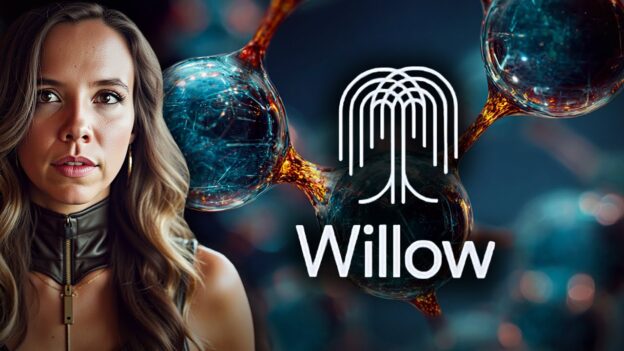
On October 22, 2025, Google achieved an unprecedented milestone in quantum computing with their Willow chip, setting the stage for a new era in technology. This breakthrough not only surpasses traditional computational capabilities but also challenges 200 years of established physical laws, particularly those surrounding Carnot efficiency limits. The Willow chip’s ability to perform one trillion measurements has opened up new possibilities in molecular science and has fundamentally altered our understanding of what is deemed physically possible.
Video
Video Description
Join the AI Labs with the code ‘FIRSTMOVER’ to save $50 per month: https://firstmovers.ai/labs/. You can also book a free strategy call to explore AI integration solutions for your business here: https://firstmovers.ai/consulting/.
The significance of the Willow chip lies not only in its computational speed but in its profound implications across various fields. Here’s an overview of what the video covers:
– The record-breaking 99.97% fidelity of Google’s Willow chip and its implications.
– The recent German scientific discovery that defies the 200-year-old thermodynamic laws.
– The transformative potential of quantum error correction in surpassing the threshold barrier.
– Introduction of the Quantum Echoes algorithm and its impact on processor operations.
– Projected timeline for the transition of quantum technologies from experimental labs to industrial applications (18-36 months).
– Exploration of the three-phase pattern that is accelerating the development of fault-tolerant quantum computing.
– Examination of the impact on fields such as drug discovery, materials science, AI, and cryptography.
– Discussion of the less-discussed, potential negative impacts of quantum technologies.
Quantum computing is poised to redefine the landscape of technology and science, bridging gaps that once seemed insurmountable. Organizations that adapt to this quantum leap will shape the future, while those that hesitate risk obsolescence. This technological shift, more pivotal than the advent of the internet or AI alone, sets the foundation for exponential advances across all fields of human endeavor.
The urgency to engage with quantum computing technologies is clear: either adapt and ride the wave of this transformative journey, or be overwhelmed by the tidal forces of change.
About Julia McCoy
Julia McCoy is the CEO of First Movers, a company at the forefront of AI and emerging technologies. With a focus on helping businesses become pioneers in an era of exponential change, Julia and her team offer cutting-edge AI strategies and integration solutions.
Explore more about First Movers and engage with their services:
– AI Labs offers over 50 AI courses and live weekly classes. Use the code ‘FIRSTMOVER’ for a $50 monthly discount: https://firstmovers.ai/labs/.
– Book a free strategy call to get tailored AI integration solutions for your business: https://firstmovers.ai/consulting/.
Stay connected with Julia McCoy through her social media and educational platforms:
– Twitter: https://twitter.com/juliaemccoy/
– YouTube: https://www.youtube.com/juliamccoy
– LinkedIn: https://www.linkedin.com/in/juliaemccoy/
Don’t forget to check out Julia’s other channel for more insights: http://www.youtube.com/@HopeandHealingwithJulia.
So many people ask me how to get into quantum computing – but most of them don't even know why they want to work in quantum computing in the first place. They think it's "interesting" and it "combines all their interests", but nothing beyond that. AND THAT'S OK – for now.
I know tons of people spending lots of money on “quantum computing masters degrees” because they like the idea of working in quantum computing, but don’t actually know what it’s going to be like and don’t actually know what they want to do.
Thinking about a career in quantum computing? Before you dive in, ask yourself: Is this really the right path for me? In this video, I walk through essential questions to help you decide if quantum computing truly aligns with your interests and goals.
0:00 – Is quantum right for you?
1:00 – My problem with quantum computing education
2:55 – How can I contribute to quantum computing?
5:15 – How do I decide if quantum is right for me?
6:10 – Question 1: What technical work do you enjoy?
6:45 – Question 2: What skills do you need to develop?
8:10 – Question 3: How can you apply your skills to quantum?
9:10 – Question 4: Why do you want to work in quantum computing?
While I may work for IBM, my opinions and ideas I share online to not represent IBM's opinions or views. My opinions and ideas are my own.